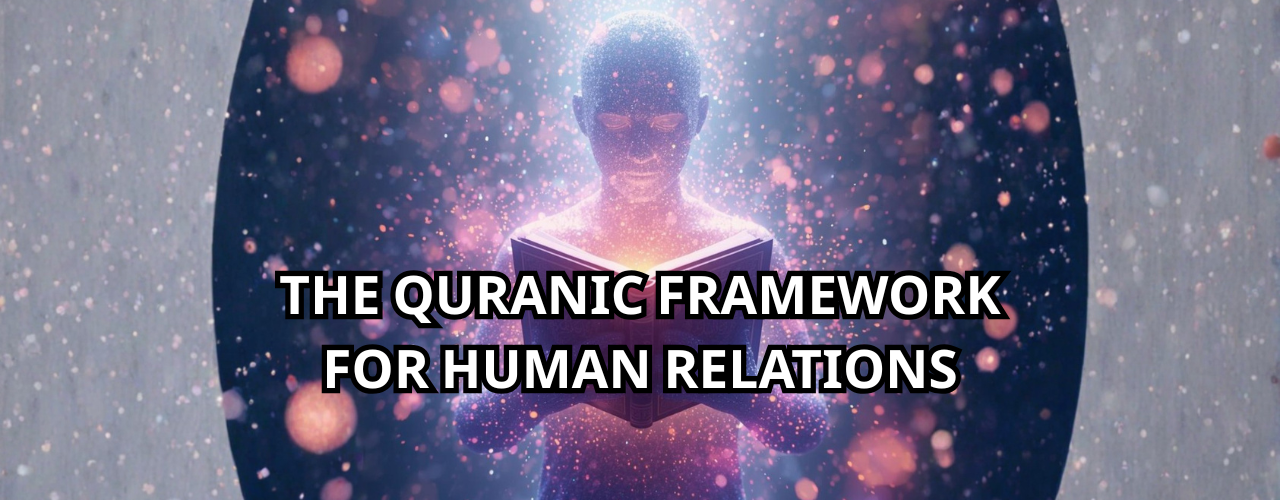
The Quranic Framework for Human Relations: A Thematic Study of Surat an-Nisa
Legislative Guidance for Social Cohesion
Surat an-Nisa provides comprehensive directives and legislation governing diverse human relationships. These frameworks serve as the bedrock for social justice and ethical conduct, as evidenced by the following models.
Fiduciary Duty Toward Orphans: The Surah establishes strict protections for the property of orphans: “And give to the orphans their properties and do not substitute the defective [of your own] for the good [of theirs]. And do not consume their properties into your own. Indeed, that is ever a great sin.” (Verse 2).
Marital Relations and Jurisprudence: It addresses the complexities of the marital bond, including dower (mahr), divorce, conflict resolution, inheritance between spouses, and the concept of guardianship (qiwamah): “Men are the protectors and maintainers of women by [right of] what Allah has given one over the other and what they spend [for maintenance] from their wealth.” (Verse 34).
Inheritance and Economic Rights: The Surah codifies the relationship between heirs and the deceased: “For men is a share of what the parents and close relatives leave, and for women is a share of what the parents and close relatives leave, be it little or much—an obligatory share.” (Verse 7).
Kinship and Prohibited Relations: It defines the boundaries of family ties and consanguinity: “Prohibited to you [for marriage] are your mothers, your daughters, your sisters, your father’s sisters, your mother’s sisters, your brother’s daughters, your sister’s daughters, [and] your milk mothers…” (Verses 23-24).
Sanctity of Private Property: The Surah affirms the right to individual ownership and the prohibition of financial transgression, establishing the legal basis for the transfer of wealth: “O you who have believed, do not consume one another’s wealth unjustly but only [in lawful] business by mutual consent.” (Verse 29).
The Inviolability of Human Life: A profound emphasis is placed on the sanctity of life: “And do not kill yourselves [or one another]. Indeed, Allah is to you ever Merciful.” (Verse 29)—a command encompassing both the prohibition of suicide and the murder of others. This is further reinforced in Verse 92: “And never is it for a believer to kill a believer except by mistake.”
The Ethics of Social Interconnectivity: The Surah extends its reach to family members, neighbors, the needy, and friends: “Worship Allah and associate nothing with Him, and to parents do good, and to relatives, orphans, the needy, the near neighbor…” (Verse 36).
The Universal Call to Piety and Oneness
Through these detailed regulations, we find the profound wisdom behind the Surah’s opening invocation:
“O mankind, fear your Lord, who created you from one soul and created from it its mate and dispersed from both of them many men and women. And fear Allah, through whom you ask one another, and the wombs. Indeed Allah is ever, over you, an Observer.” (Surat an-Nisa: 1). This prologue serves as a reminder that all legal and social obligations are rooted in a shared origin and a singular divine accountability.
Observations on Human Dignity in Surat an-Nisa
The opening verse of this Surah serves as a profound psychological and ethical mandate. It reminds us that when we engage with others—whether in cooperation, confrontation, or dispute—we must recognize our shared biological and spiritual origin. By tracing all of humanity back to a single soul and a common pair of ancestors, the Quran establishes two internal deterrents against injustice.
The first is the Pillar of Piety (Taqwa), which is a conscious state of divine awareness that actively restrains the individual from aggression and corrects the trajectory of their behavior.
The second is the Pillar of Humanity, representing a fundamental recognition of kinship that reinforces piety or acts as a secondary safeguard should a person’s spiritual resolve falter.
The Restoration of Female Agency and Universal Humanity
A central theme of the Surah is the categorical affirmation that women are fully included in the definition of “Humanity,” possessing the same spiritual and social standing as men.
The significance of this declaration is best understood against the historical context and backdrop of the era of revelation. At that time, many civilizations and religious traditions either stripped women of their human status—regarding them as inherently impure—or relegated them to second-class citizens who were owned, inherited, and denied the right to possess property.
This shift reinforces that Islam is fundamentally a “Religion of Humanity.” Human dignity is a primary axis around which Islamic teachings, legislation, and ethics revolve. Therefore, the contemporary debate by some who limit the scope of “Humanitarian Work” in favor of “Islamic Work” misses a critical Quranic truth: advocating for humanity is inherently an act of harmony with the Quran.
The Human-Centric Focus of Divine Law
The Quran does not elevate the human soul to the level of divinity, nor does it encourage rebellion against the Creator. Rather, it places the individual on the correct path of self-discovery. By centering Divine Law around human needs, Islam enables a person to understand their origin, purpose, and final destination. It provides the tools to manage multifaceted human relationships in a way that preserves the rights of the individual without diminishing the rights of the collective.