
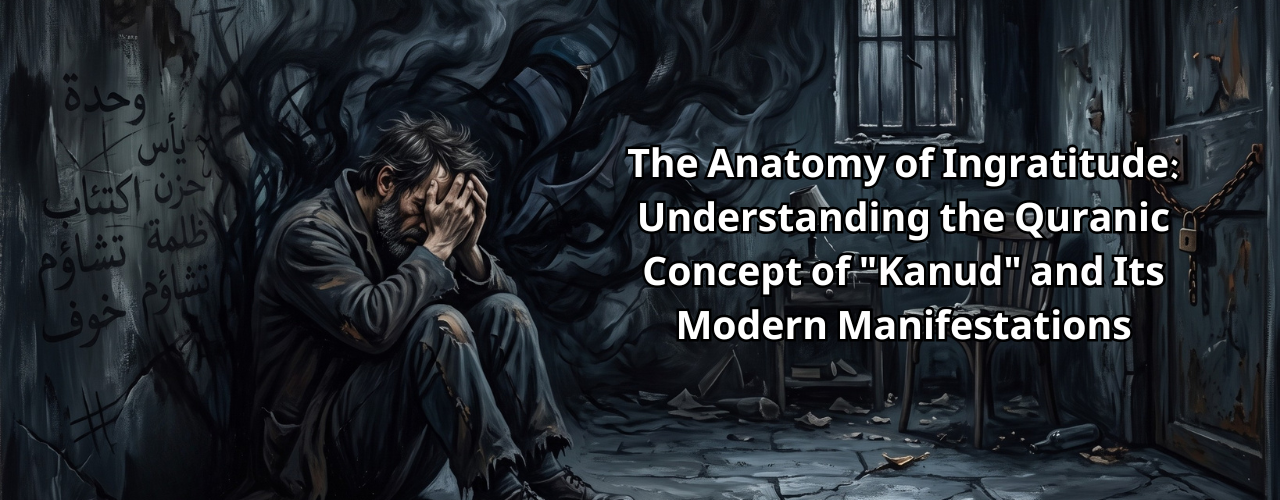
The Anatomy of Ingratitude: Understanding the Quranic Concept of “Kanud” and Its Modern Manifestations
Spiritual Ingratitude and the Satanic Project
In a profound theological analysis of the Quranic verse, “Truly man is ungrateful to his Lord” [Al-Adiyat: 6], religious scholars highlight the intense linguistic emphasis employed by the Divine text to drive this point home. The verse utilizes a triple layer of confirmation: starting with the emphatic particle ‘Inna’ (Truly/Indeed), followed by the grammatical advancement of the prepositional phrase ‘li-rabbihi’ (to his Lord), and culminating with the emphatic prefix ‘La’ attached to the predicate ‘kanud’ (ungrateful). This accumulation of emphasis signifies the absolute certainty of this human trait.
Furthermore, this declaration serves as the climax to the powerful oaths that open Surah Al-Adiyat, where Allah swears by the panting warhorses, the sparks they strike, and their dawn raids that stir up dust and penetrate enemy gathering forces. All this dramatic imagery leads to the central thesis: Mankind, indeed, is kanud to his Lord.
But what does kanud truly mean? Lexicographers, citing ancient authorities like Ibn Faris, trace the root of the word to a sound linguistic origin denoting “cutting” or “severing.” A primal example is “the kanud land,” referring to soil that ceases to yield produce; it was expected to flourish, yet it cut off that expectation.
Consequently, kanud describes the one who denies blessings (an ingrate). He is labeled thus because he “cuts off” thanks. He is expected to show gratitude for favors received, but he abruptly severs this expected behavior.
Theologically, this state of ingratitude is identified as a direct outcome of the “Satanic Project.” The Quran quotes Satan’s vowed mission to misguide humanity: “…I will come at them from their front and their back, from their right and their left, and You will not find most of them to be grateful” [Al-A’raf: 17].
Surah Al-A’raf provides a striking, real-world example of kand—acting contrary to the expectation of showing gratitude to God. The text depicts a couple praying desperately during pregnancy: “It is He who created you from a single soul, and from it made its mate… they both pray to God, their Lord, ‘If You give us a healthy child, we will surely be grateful.’ Yet when He gives them a healthy child, they attribute partners to Him in what He has given them. God is far above the partners they attribute to Him!” [Al-A’raf: 189–190].
This behavior stands in stark contrast to the divine imperative: “No, worship God and be among the grateful” [Az-Zumar: 66]. Worship is thus defined as the expected behavior that is in harmony with God’s blessings.
Scholars note that the Quran interchangeably uses the terms kanud (intensely ingrate) and kafur (disbelieving ingrate) to describe this human condition. In Surah Az-Zukhruf, it states: “…Man is truly and clearly ungrateful” [Az-Zukhruf: 15]. Man, expected to believe, instead severs that expectation through denial. Rather than worshipping the One God, he sets up equals and associates partners with Him, acting in a completely contrary manner through repeated acts of disbelief (kufr), thus becoming kafur.
The 2nd Sermon: Psychological Ingratitude and the Negative Personality
Building upon the spiritual foundation established in the first sermon regarding man’s ingratitude towards his Lord, the discourse shifts focus to the manifestation of kand in one’s outlook on life—commonly referred to as the “negative personality.”
The negative individual, who obsessively focuses on the empty half of the glass while ignoring the full half, is inherently a kanud. Such a person acts contrary to the rational expectation of balancing negatives with positives. Analysis reveals several prominent traits of this modern kanud personality:
Perpetual Anxiety: They suffer from a profound lack of tranquility, trapped in a cycle of negative expectations and fear of the future. They magnify negative images and engage in incessant complaining: “Everything has become expensive,” “I am always sick,” “I have no luck,” “Everything is against me.” They disregard existing blessings—wealth, health, safety, family, home, and employment—magnifying momentary negatives until they obscure the entire picture of grace. This mindset has severe psychological, mental, physical, and behavioral consequences, often leading to depression.
Resistance to Change: Because they focus exclusively on the negatives, their fears are hyper-inflated, causing them to resist any development or improvement. For example, while the field of risk management in economics balances risks against positives to make decisions, a negative personality in a position of power would destroy any project, as they are incapable of seeing anything but magnified risks.
Inability to Adapt: Change is an inevitable law of life. Since the negative person resists change, they inevitably resort to grumbling about variables, “cursing the times,” and gradually withdrawing into isolation.
Lack of Initiative: The negative individual is non-proactive. Adopting the role of a victim, they wait for solutions to descend upon them, expecting the world to change for their benefit without personal effort.
Emotional Dictatorship: They are ruled by their feelings and sensations rather than rational intellect.
Violent Reactions: Existing under immense psychological pressure due to the aforementioned traits, they often exhibit violent outbursts. This phenomenon is observable in intellectual, cultural, and religious circles when encountering dissenting or new opinions. Some secular thinkers cannot tolerate ideas rooted in religious vision, despite their intellectual status demanding openness. Conversely, some religious scholars cannot bear criticism or contemporary views, reacting violently and demanding absolute followership. While not the sole cause, a negative personality is a major driver of these extreme stances.
Conclusion
In conclusion, the Quranic warning—”Truly man is ungrateful to his Lord”—is a call to self-reflection. We are warned against acting towards God in a manner contrary to what is rationally and spiritually expected. Divine, sustainable blessings must be met with nothing but gratitude.
However, the Satanic project, aimed at rendering humanity intensely ungrateful (kafur), places us all in danger of becoming victims. This reality necessitates constant vigilance, caution, and an abundance of God’s remembrance and gratitude from the believer. Furthermore, kand manifests not just towards God, but towards life and people through a negative personality that obsessively dwells on negatives while ignoring positives, exposing the individual to severe psychological, mental, physical, and behavioral perils.