The Etiquette of Prophetic Dialogue in the Social Media Era: Elevating Digital Discourse
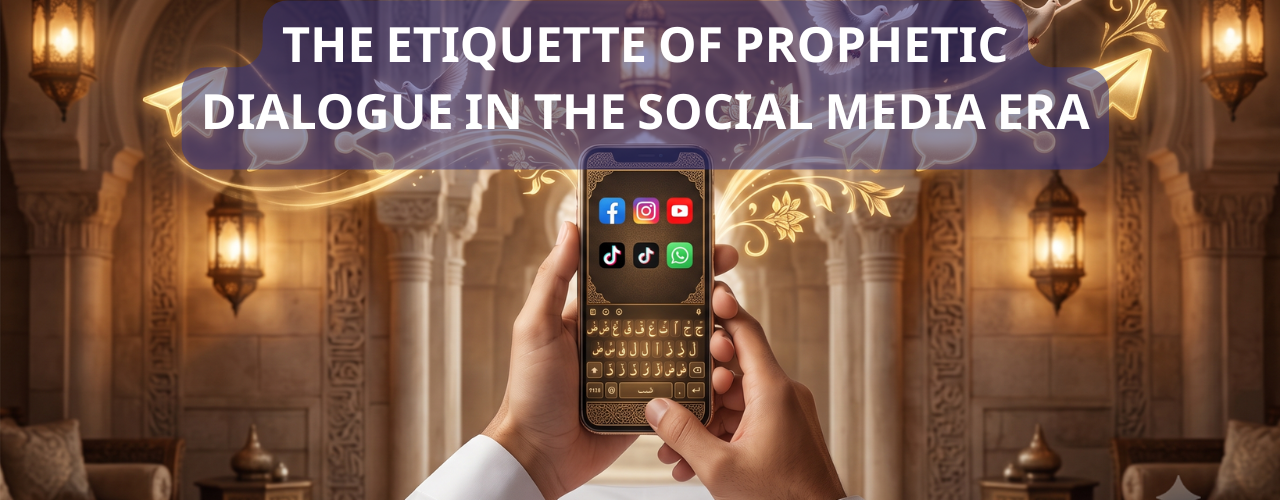
In an era dominated by instantaneous connectivity, screens have effectively transformed into pulpits and social media networks into turbulent arenas of debate. Yet, this virtual realm frequently suffers from an acute ethical deficit characterized by aggressive argumentation, systemic cyberbullying, impulsive amplification of unverified claims, and a near-total collapse of genuine listening. As we commemorate the passing of the Prophet Muhammad (PBUH&F), there is an urgent societal imperative to draw upon his sublime pedagogical methodology to re-anchor our digital conduct in dignity, intellectual maturity, and spiritual responsibility.
The Prophetic Paradigm of Attentive Listening and Verification
The contemporary digital landscape encourages a culture of rapid reaction where users rush to comment, critique, and condemn before comprehending the broader narrative. The Prophetic methodology establishes that complete, disciplined, and dispassionate listening constitutes the foundational prerequisite for any constructive interaction.
A historic manifestation of this ethos occurred when the Quraysh leadership delegated Utbah ibn Rabi’ah to negotiate with the Prophet (PBUH&F) in an attempt to halt his mission. Utbah presented a prolonged, combative monologue laden with accusations that the Prophet was fracturing social cohesion, insulting ancestral traditions, and pursuing personal enrichment or tribal dominion. Throughout this hostile indictment, the Prophet maintained unyielding patience, neither speaking over Utbah nor dismissing him prematurely. Only when Utbah ceased speaking did the Prophet courteously inquire whether he had concluded, and upon receiving affirmation, responded with profound poise by reciting pertinent revelation from the Holy Quran.
Translating this discipline into modern digital engagements demands intentional restraint. A responsible interlocutor must consume the entire written discourse or view the complete audiovisual material before formulating a rebuttal. Dismissing a complex argument based merely on an inflammatory opening phrase, or rejecting a perspective simply because it challenges personal preconceptions, mirrors the very intellectual carelessness that the Prophetic paradigm came to reform.
Eradication of Digital Contagion and the Ethics of Information Flow
Modern networking algorithms are structurally engineered to incentivize outrage, sensationalism, and high-velocity distribution, creating fertile ground for fabricated narratives and coordinated disinformation campaigns.
To inoculate society against such epistemological chaos, the Prophet (PBUH&F) formulated a decisive legal and moral criterion: “It is enough of a lie for a person to repeat everything he hears.” This maxim places direct moral culpability on the individual who chooses to circulate unvetted material; transmission without verification is fundamentally equivalent to fabrication, effectively transforming the heedless sharer into a functional conduit for malicious agendas.
Divine revelation delivers unambiguous warnings against this reckless propagation. In the context of the incident of slander (Al-Ifk), the Holy Quran sternly admonishes: “When you took it up with your tongues, and spoke with your mouths things you did not know [to be true], you thought it was trivial, but to God it was very serious. When you heard the lie, why did you not say, ‘We should not repeat this—God forbid!—It is a monstrous slander’? God warns you never to do anything like this again, if you are true believers” [Surah Al-Nur: 15-17]. This is reinforced by the broader evidentiary imperative: “Believers, if a troublemaker brings you news, check it first, in case you wrong others unwittingly and later regret what you have done” [Surah Al-Hujurat: 6].
In practical terms, users must institute an intentional pause before executing an amplification mechanism—be it sharing, retweeting, or forwarding—asking whether the data has been rigorously verified through credible sources. Participating in the artificial elevation of speculative trends or circulating private misfortunes under the guise of casual curiosity violates basic communal sanctity. While rumors in the early Islamic era were bounded by geography and physical reach, contemporary digital footprints are permanent, indexed, and globally accessible within seconds, drastically magnifying the ethical gravity of every reckless keystroke.
Refined Articulation and the Deconstruction of Digital Anonymity
The veil of screen-mediated anonymity frequently emboldens individuals to resort to profanity, slander, and ad hominem hostility, operating under the dangerous illusion that invisibility equals impunity. The Prophetic model unequivocally binds authentic faith to unyielding self-governance, demonstrating that moral consistency cannot be compromised by situational obscurity.
The Prophet (PBUH&F) was neither obscene, nor prone to curses, nor abusive in speech, explicitly instructing his companions that “a true believer is not a defamer, nor a curser, nor one who is obscene or abusive.” This standard remains categorical whether an author’s legal name is visible or hidden behind an alias, because moral obligations are ontologically indivisible. The conscience must remain awake to the divine reality that God “knows what is said in secret and what is even more hidden” [Surah Ta-Ha: 7], and that the human being “does not utter a single word without an ever-present watcher” [Surah Qaf: 18].
Consequently, disciplined participation requires addressing ideas, conceptual frameworks, and factual errors rather than launching venomous attacks against an author’s persona, appearance, or background. When confronted with deliberate toxicity, provocation, or bad-faith disputation, the correct response is illustrated in the divine description of the servants of the Beneficent: “…and when the ignorant address them, they reply, ‘Peace'” [Surah Al-Furqan: 63]. Dignified disengagement, whether through silence, selective muting, or platform blocking, preserves intellectual integrity without descending into reciprocal mudslinging.
The Digital Sphere as an Ethical Frontier
The commemoration of the Prophet’s passing finds its highest realization not in static sentimentality, but in transmuting our lived reality into an authentic reflection of his enduring character. The digital domain is neither a moral vacuum nor an autonomous sphere exempt from divine accountability; it is a direct extension of our social, intellectual, and spiritual presence.
Digital stewardship demands transforming virtual interactions into avenues of edification, analytical rigor, and principled decorum. Where genuine inquiry exists, it should be met with verified knowledge and impeccable manners; where deliberate frivolity reigns, the mandated path is conscious disengagement, adhering to the divine injunction: “When you come across people who speak with mockery about Our revelations, turn away from them until they move on to another topic. If Satan should make you forget, then, when you have remembered, do not sit with those who are doing wrong” [Surah Al-An’am: 68]. Every digital artifact, comment, and shared claim becomes an indelible entry within an individual’s metaphysical record, demanding that nothing be typed which one would regret confronting on the Day of Reckoning.